









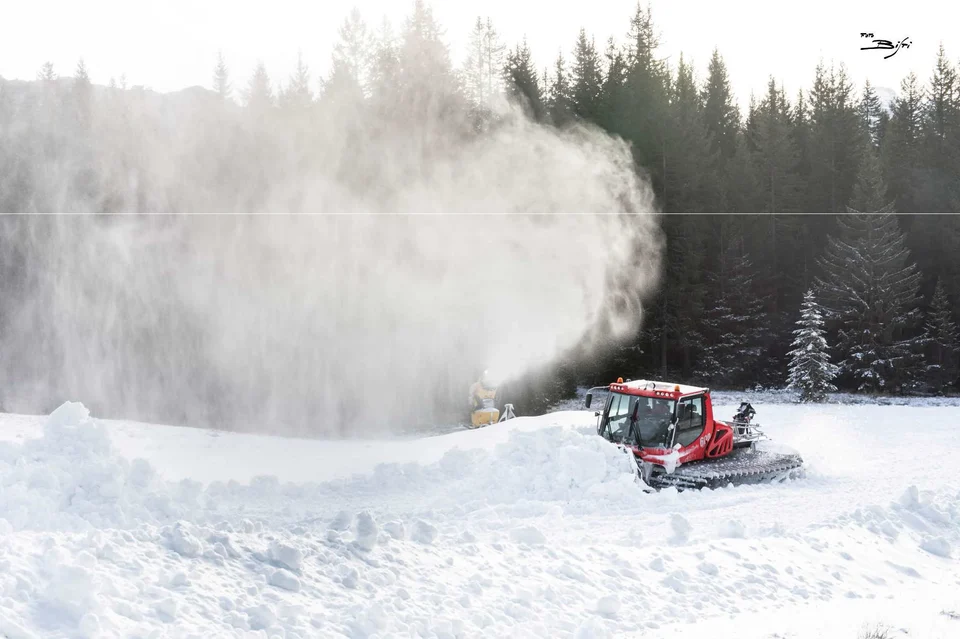
Technical snowmaking depends on the combination of temperature and humidity. The +3 °C example applies only to very dry air, not to every evening.
A snowmaking machine operating while the thermometer shows a temperature above freezing may seem like a contradiction. To understand what is happening, however, reading the air temperature alone is not enough: humidity must also be considered. In technical snowmaking, the two values are assessed together through the wet-bulb temperature.
TechnoAlpin, a manufacturer of snowmaking systems, provides a specific example: in particularly dry conditions, with relative humidity around 20%, snow can be produced even at an air temperature of +3 °C. This is not a universal threshold and does not mean that every machine can do so under any conditions above freezing.
Two equally cold evenings can be very different
Wet-bulb temperature takes into account the relationship between air temperature and humidity. The manufacturer indicates approximately −2.5 °C wet-bulb temperature as the starting threshold for its conventional systems: this figure must not be confused with the temperature shown by an ordinary thermometer.
Imagining two evenings with the same temperature, one dry and one humid, helps explain why a weather app alone does not describe all the possibilities for snowmaking operations. To compare them, both measurements must be taken at the same place and at the same time. A value recorded in the village does not automatically describe what is happening along a piste higher up the mountain.
Water temperature also contributes to the process. Water that is already cold, close to freezing, provides favourable conditions: not everything therefore depends on the number displayed by the weather station.
From sprayed water to the surface of the piste
In the systems described by TechnoAlpin, nozzles and nucleators work to create very small droplets and nuclei around which snow forms. Fan guns and lances use different solutions to distribute the material through the air and make use of its fall.
For a skier, the interesting point is not simply seeing a machine switched on. Snow production in progress does not confirm that a piste is ready for the public: this is different information from the opening status reported in the operator’s bulletin. Photographing a snowmaking machine and announcing that the season has already started would confuse two separate facts.
The same applies to the +3 °C example. It is useful for explaining why humidity and temperature must be considered together, not as a slogan claiming that snow can be produced regardless of the weather. When a resort describes the work of its snowmaking equipment, the information that truly clarifies the situation is temperature, humidity, location and time of measurement.
When planning a day of skiing, another piece of information remains decisive: which lifts and pistes are actually open. The technology explains how snow is prepared; the operating bulletin tells visitors where they can use it.
Read also: How snow is preserved during the summer.


No comments yet