









Curé Deslauriers preserves the story of a priest who connected village life with the birth of the ski resort.
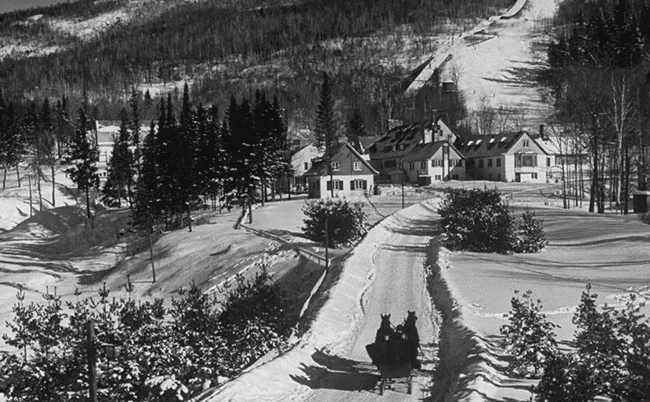
On the trail map of Tremblant, in Québec, Curé Deslauriers is more than just the name of a ski run. It commemorates Charles-Hector Deslauriers, the priest who helped connect the local community with ski tourism. The resort tells his story in its archive: at the beginning of winter, boys and girls went to the chapel to have their skis blessed, and the parish priest organised days on the snow for them.
It is a detail that changes the way a map can be read. Alongside difficulty symbols appear people, economic decisions and village traditions. The name remains a reference point for navigating the pistes, but it also preserves a memory that cannot be seen from the chairlift.
A bridge between the village and new visitors
Deslauriers was appointed founding parish priest of Mont-Tremblant on 21 July 1929. According to the operator’s historical account, he soon understood that the timber industry would not be enough to revive the local economy. Meeting Joe and Mary Ryan allowed him to see another possibility for the community.
His role was not simply that of a spectator at the birth of the resort: he became a link between residents and visitors. The blessings of skis and the days organised for children illustrate precisely this relationship, in which the new activity also became part of the lives of local families.
The run that now bears his name was originally named after Sir Edward Beatty. The change from one name to the other shows how the trail map is also a record of local memory: not every reference appearing on it has remained unchanged since the beginning.
A story to discover on the south side
In the official historical account, Curé Deslauriers is marked with a blue square on the south side. This symbol must be interpreted according to the local classification, not as an automatic equivalent of an Italian blue piste. The story behind the name does not, by itself, establish whether the descent is suitable for every member of the group.
For someone spending a holiday at Tremblant, this can become a small journey of discovery even before skiing: find the name on the map, understand who it refers to and then decide whether to include the run in the day’s programme according to ability level and whether it is actually open.
There is no need to turn every turn into a history lesson. It is enough to know that behind that sign lies the memory of children bringing their skis to the chapel and of a village searching for a different future. The descent belongs to the mountain; its name continues to connect it with the community that grew at its foot.


No comments yet