









We have received and are publishing the following press release from Funivie di Campiglio.
Building the lower section of the Ursus Snowpark requires an enormous volume of snow (nearly 200,000 cubic meters!) that cannot be produced entirely and within a short timeframe even by the highly efficient programmed snowmaking system of Funivie di Madonna di Campiglio.
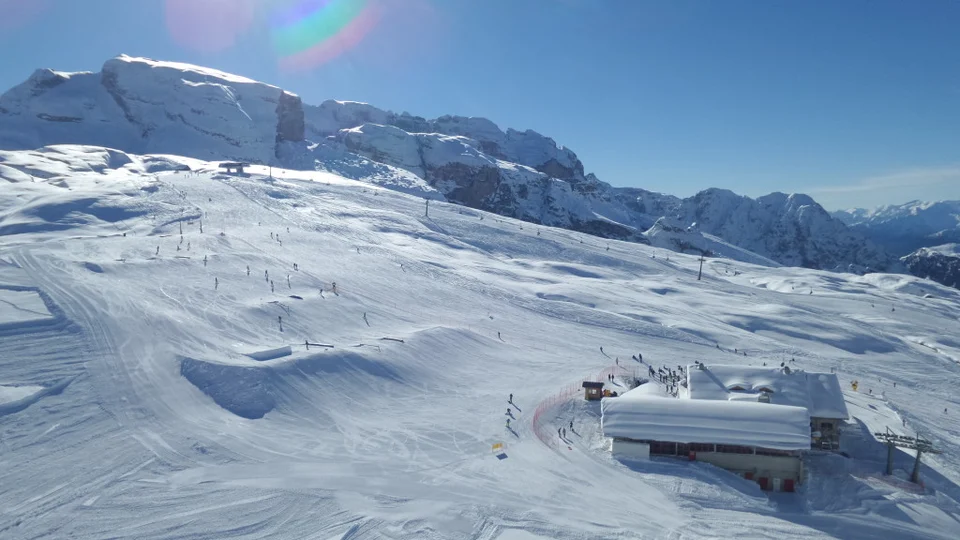
The natural terrain underlying the lower section of the snowpark—typical of the Dolomites—is particularly rugged and uneven, full of depressions and hollows that must be leveled and smoothed out by filling in the gaps. To accomplish this at the start of every winter, snow groomers move huge quantities of natural snow that must fall during the autumn months.
In fact, the volume of snow needed just to prepare the base supporting the terraces for the park features exceeds the amount of snow required to prepare the slopes of the entire Grostè sector! By way of example, the cubic meters of snow used solely for the landings of the 4 kickers on the “Large” line would be enough to cover the entire “Corna Rossa” slope and part of the “Graffer” run! Indeed, this winter 160,000 cubic meters of machine-made snow were produced to cover all the ski runs in the Grostè sector.
These figures help explain why it was impossible to prepare the base at the beginning of this winter season due to a complete lack of precipitation—a dry spell described by experts from the Province of Trento as “one of the driest periods ever recorded.” Even today, now that snow has finally arrived at high altitude, the amount that has settled on the ground without being scoured away by the wind is still insufficient for snow groomers to pack a base without damaging the machines themselves and the underlying ground—and, above all, without being able to guarantee safe, high-quality conditions for the snowpark’s many users.
One might wonder why, if the problem is uneven terrain, the ground is not leveled mechanically during the summer using bulldozers and excavators, as has been done on most of the other ski runs in the resort. The reason is that the Ursus Snowpark sits atop the Grostè in an area of exceptional environmental value and rare natural beauty, located within the “Brenta Dolomites” Special Area of Conservation (SAC) as well as inside the Adamello Brenta Nature Park: a prized Dolomite environment recognized as a UNESCO World Heritage Site, where permits for excavation, earthmoving, or terrain leveling cannot be granted.
Funivie Madonna di Campiglio Spa has long been aware of the challenges posed by the ungraded terrain beneath the lower section of the Ursus Snowpark and has applied on multiple occasions for authorization to level even part of the ground—permits that have never been granted for the environmental reasons explained above.
Even without terrain grading, because the Grostè area is normally very snowy, the Ursus Snowpark has always been built primarily using natural snow, which at 2,500 meters above sea level is almost never in short supply; unfortunately, for the very first time this winter, the lift company and snowpark managers were confronted with an unprecedented drought. Even so, thanks to more favorable terrain and machine-made snow, the upper section of the snowpark opened on schedule in mid-December and is currently being expanded.
What are the possible solutions to prevent this situation from happening again?
Assuming that the total lack of precipitation from late October to early January was an exceptionally rare event that hopefully will not be repeated, one potential alternative would be to relocate the Ursus Snowpark entirely to another sector of the Madonna di Campiglio ski area—for instance, to the Pradalago sector where the Mini-Ursus park is currently located. However, moving the main park from 2,500 meters down to 2,000 meters would entail other drawbacks, such as being unable to open in late November alongside the first ski slopes and the risk of having to close earlier in spring due to the lower elevation and different sun exposure.
Keeping the Ursus Snowpark atop the Grostè, on the other hand, is backed by historical data showing that ever since Ursus was founded in the year 2000, early-season snow at 2,500 meters had never failed to arrive—this year’s drought was an extreme, rare anomaly with broader economic and environmental implications.
Funivie di Madonna di Campiglio Spa continues—and will continue—to believe and invest in the snowpark and in the Freestyle sector, as demonstrated by the recent purchase of a brand-new “PB400 Park Pro 4F” snow groomer dedicated exclusively to the snowpark and the in-house fabrication of 6 new rail features. Our goal each year is to deliver an ever-better service upholding the standards of quality and safety that define the entire ski area at the foot of the Brenta Dolomites.
Both the lift company and the Ursus Snowpark team remain committed to preparing the lower section—or part of it—as soon as snow conditions allow.


No comments yet