









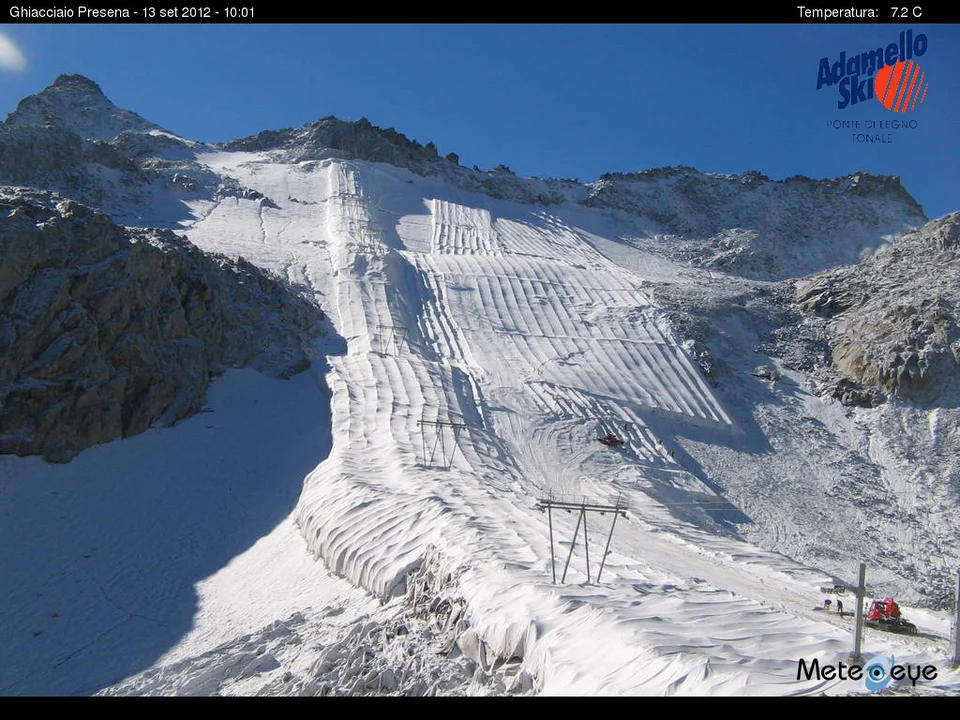
 Operations have begun to uncover the Presena glacier, which spent the summer shielded from the sun’s rays thanks to the vast blanket of geotextile sheets laid out in June by the Carosello company to limit melting. Once again this year, the sheets performed their job to perfection, saving a 2-meter-thick layer of snow that will form the base for the 2012–2013 winter season.
Covering the glacier is part of a joint project involving the Autonomous Province of Trento and the University of Milan, which monitors and studies the effectiveness of the sheets. The success of this protective “blanket” has led to its expanded use over the years; this year, a glacier surface area of 100,000 square meters was covered.
The results from the summer of 2012 once again confirm the usefulness of geotextile sheets against the increasingly intense heat gripping glaciers during recent summer seasons. In the summer of 2012, temperatures reached 15 degrees at 3,000 m—levels never recorded in the past—causing rapid melting of both the snowpack and ancient glacier ice.
The success of the “Presena project” has also sparked a debate over the Marmolada: the glacier on the border between Veneto and Trentino suffered more than any other from the high temperatures, experiencing unprecedented ice melt even at high altitude. Reduced to a thin layer of ice, the Marmolada would benefit from an intervention similar to the one adopted for the Adamello glacier.
The snowfalls of late August and the snowfall of Wednesday, September 12 have officially marked the end of summer, bringing temperatures back to normal across all glaciers. While not a huge amount of snow fell, at least melting has stopped, making it possible to remove the sheets and start looking ahead to a fantastic new ski season.


No comments yet