









Perhaps it’s too early to talk about spring at 3,000 metres, but the thaw has begun even at the highest altitudes, and the webcams bear witness to it.
Although only for 1-2 hours a day and with an almost insignificant rise in temperature, the sun has started to warm things up even at the highest altitudes. The signs are the large masses of snow that are coming down after remaining precariously balanced for months thanks to constantly “polar” temperatures.
But what condition is the Stelvio Glacier in?
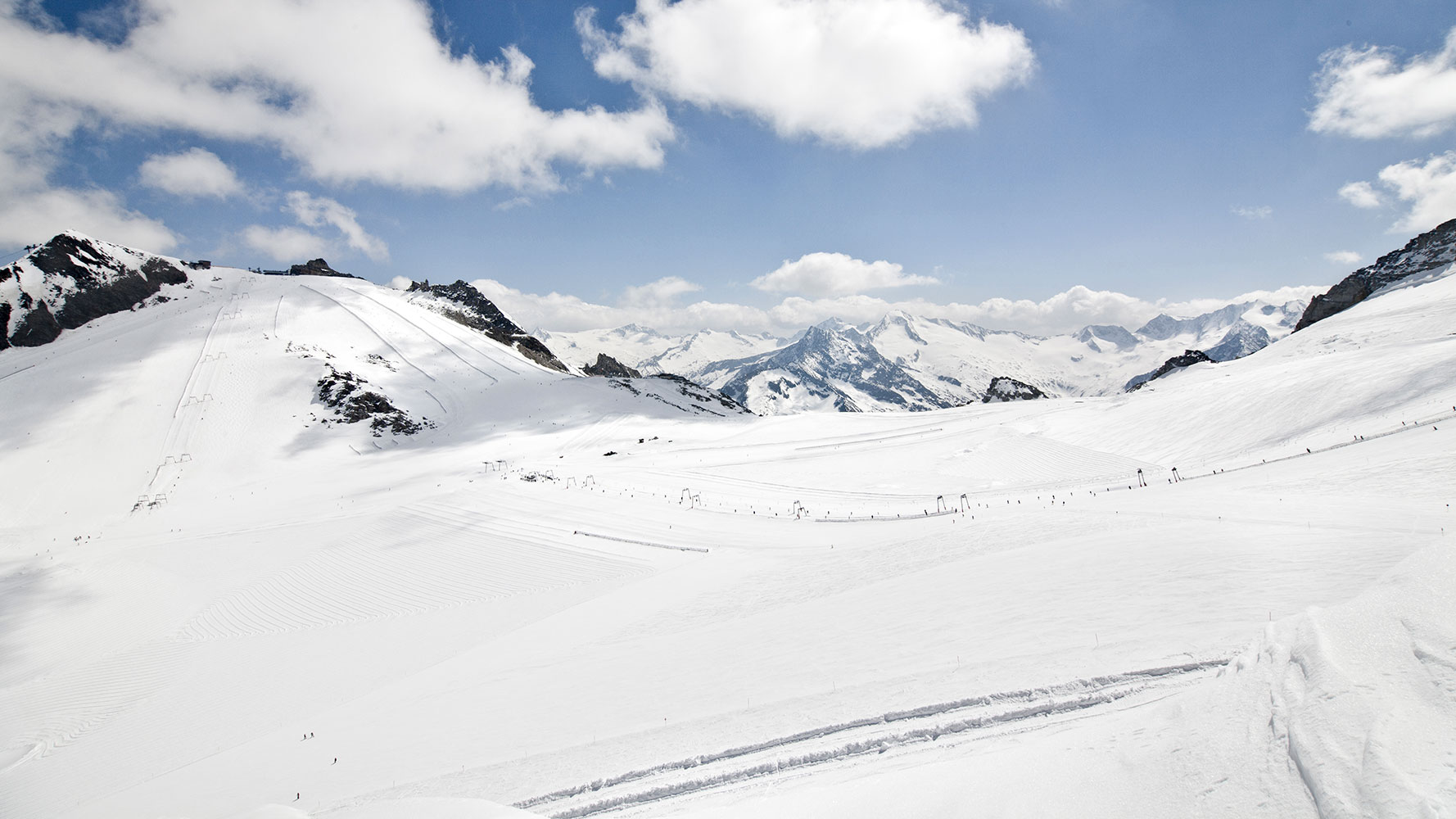
The Stelvio is already in good condition. Snowfall has been abundant this winter and temperatures extremely harsh, so much so that on more than a few occasions they came close to -30°, and for 2 months the maximum hovered around -10°.
Good results already at 2,700 metres and good conditions on the glacier too (3,100-3,400 metres).
Contrary to what one might think, this winter has been snowier for the Stelvio Glacier for 2 reasons:
- Winter 2009 brought heavy precipitation at medium-low altitudes, which meant harsh temperatures higher up, effectively preventing abundant snowfall. The winter now drawing to a close, on the other hand, has brought snowfall at higher altitudes, with some fluctuations that saw snow only above 2,000 metres.
- Winter made itself felt more strongly in South Tyrol, with heavier precipitation than in other areas
A good omen for the summer season, but that’s not all…
Glaciers build up their largest snow masses in late autumn and in spring. Although autumn snowfalls are more important than spring ones (during the winter they have time to consolidate), the latter are not to be sniffed at, and they have already made up for disastrous autumns and winters in the past.

These snowfalls usually begin towards the end of March and the first days of April. To “see them in action” we will have to wait for the snow level to rise to 1,600-1,700 metres, which ensures milder temperatures (usually -3°).
Will the glacier hold out this summer?
The snow situation on glaciers cannot be predicted in the long term, and often not even in the short term. Large winter accumulations don’t mean much if the following summer turns out to be very hot.
What has been having an increasing impact in recent years is not snow accumulation, which is almost unchanged at the highest altitudes, but summer temperatures.
Global warming has led Italian glaciers to go through as many as 30 days of continuous melting, in other words 30 days in a row with minimum temperatures above 0 degrees.
A striking example comes from the data from the Aosta Valley.
Although winter 08/09 set records in terms of precipitation for the Aosta Valley glaciers, this did not safeguard the glaciers, which at the end of the summer once again showed a negative balance.
Let’s hope this won’t be the case for the Stelvio. All we can do is hope for a good spring and a mild summer.


No comments yet