









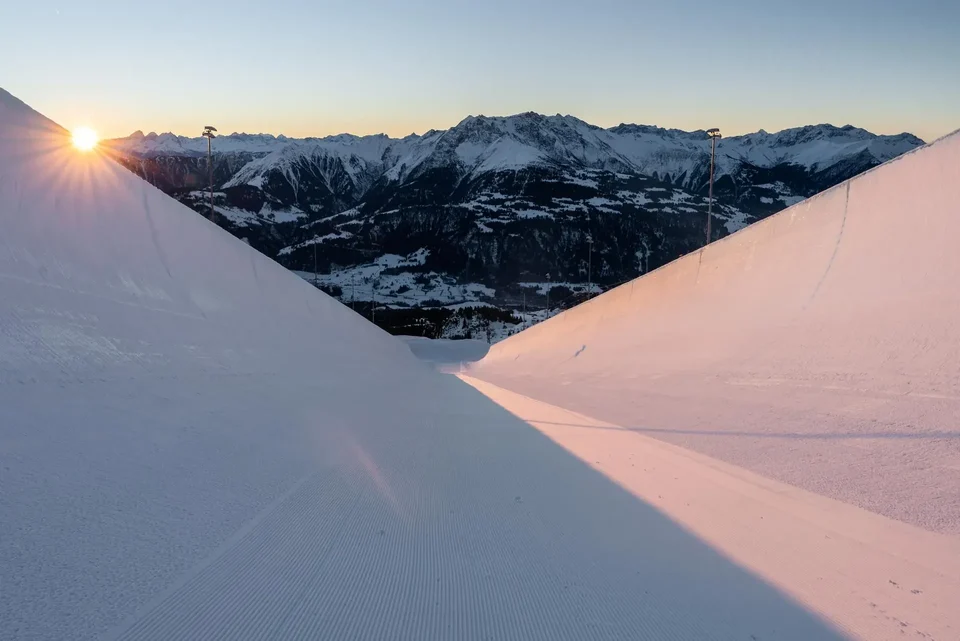
From Vorab in 1985 to the Crap Sogn Gion superpipe, the story moves from shovels to shaping machines. Snow must be built and maintained, not merely piled up.
The first halfpipe at Laax was fifty metres long, with walls around two metres high. In 1985, on the Vorab glacier, it was shaped by hand. The operator’s chronology begins with this structure to explain the evolution of a feature that today can seem like a natural part of the winter landscape.
A halfpipe, however, is an engineered structure: two walls joined to a floor, with a shape that must be recreated and maintained. The difference between a simple trench in the snow and a usable feature lies precisely in the continuity of its surfaces.
From shovels to the first dedicated machine
In 1993, an excavator entered the process, while the finishing work was still carried out by hand. The following year, the pipe moved to Crap Sogn Gion and the Pipedragon, a machine specifically designed to shape it, was used.
The transformation concerned precision as well as size. A wall cannot be considered finished simply because it has reached a certain height: its profile must allow a continuous transition from the floor towards the lip.
In 2004, the story of Laax intersected with the Pipe Monster developed with Zaugg. Subsequent construction led to the superpipe inaugurated in January 2015: the operator gives its dimensions as approximately 6.9 metres high, 22 metres wide and 200 metres long.
The machine removes snow to shape the curve
Zaugg describes its halfpipe tools as attachments connected to piste-grooming vehicles. The cutting components follow the required profile, while the removed snow is discharged through a conveyor.
The process is different from simply flattening a piste. Here, a curved cross-section must be built and repeated along the entire structure. The machine therefore works to a precise geometry, while operators prepare and maintain the snow needed to preserve it.
Accumulating snow is only one stage. The final shape also comes from what is removed, moved and finished, as happens when a material is sculpted rather than simply deposited.
Watching the park without confusing ability levels
The history of the large pipe does not mean that it is a starting point for someone entering a snowpark for the first time. The dimensions and purpose of the features must be understood through the signs, staff guidance and the visitor’s own ability level.
For visitors, watching the preparation offers another way to understand the mountain. The finished walls visible during the season conceal continuous work involving terrain design, snow management and maintenance.
The transition from the hand-shaped Vorab pipe to the superpipe tells precisely this story: not just increasing dimensions, but a change in how snow is given its shape.


No comments yet