









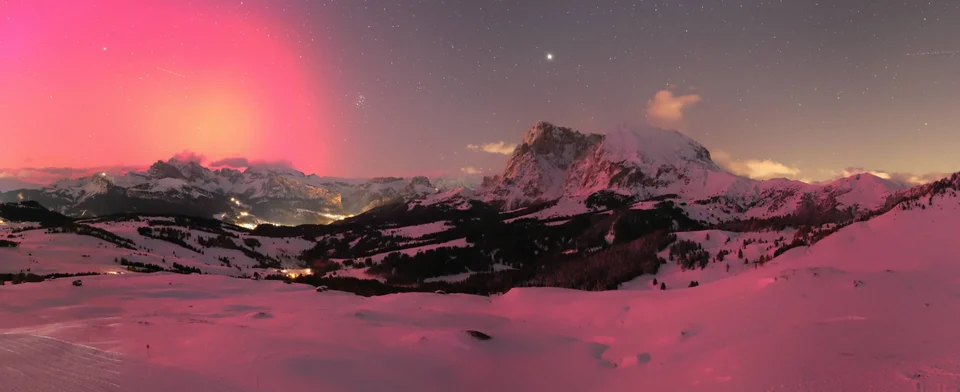
On autumn evenings, the Dolomites usually enchant visitors with sunsets that set the sky ablaze, but the surprise that enveloped the snow-capped peaks on Sunday, November 5 was of a completely different caliber. It was neither dawn nor dusk that tinted the peaks and slopes of one of the world’s most admired mountain ranges in pink, but rather a phenomenon rare and unusual for these latitudes: the Northern Lights (aurora borealis).
This extraordinary natural display wrapped the mountains in an embrace of pink light, leaving residents and tourists in awed silence, witnessing a moment that seemed straight out of a magnificent fairy tale.
The Phenomenon Captured by Webcams
The intense aurora borealis was captured by the numerous webcams positioned across the ski areas of the Dolomites, from South Tyrol to the Venetian Dolomites. In particular, the webcams of Panomax.com played a crucial role in observing this magnificent spectacle.
These weather webcams, which save images every ten minutes, made it possible to document the event in all its splendor. The aurora began to appear at 6:20 p.m. and reached peak intensity for about 10 to 15 minutes, before fading and reappearing more faintly at later times.
The result was a truly one-of-a-kind spectacle, made even more extraordinary by the recent snowfalls that had dressed both the high-altitude peaks and the valleys of the Dolomites in a pure white blanket. This carpet of snow acted as a natural screen, reflecting and amplifying the light of the aurora, creating a breathtaking visual contrast that made the experience even more magical and unforgettable.


From Alpe di Siusi to Cortina
The most fascinating scenery was recorded on Alpe di Siusi, where the aurora borealis tinted the freshly snow-covered slopes in pink, creating a dreamlike landscape. Sassolungo and Sassopiatto were bathed in this almost supernatural light, transforming the scenery into a fairy-tale setting. Plan de Corones also offered a fairy-tale view, with the aurora illuminating the sky above the Austrian Alps to the north, creating an almost surreal atmosphere.
In Cortina d’Ampezzo, the aurora framed Monte Cristallo and offered an unprecedented view of the Tofane and 5 Torri.
The Northern Lights did not spare other mountain resorts either, albeit with lesser intensity. Madonna di Campiglio and Trafoi, despite having a less privileged exposure compared to the South Tyrolean resorts, were still able to observe the phenomenon in a more subdued form. This allowed both amateur and professional photographers to capture unique moments, adding images of a celestial event rarely visible from Italian latitudes to their portfolios.
Even from the Vicenza Prealps, from Monte Grappa to Asiago, camera lenses immortalized this unique and priceless moment.
A Rare but Not Unique Event
The aurora borealis is a spectacular natural phenomenon caused by the collision of charged particles from the solar wind with Earth’s magnetic fields. Usually confined near the poles due to the specific shape of Earth’s magnetic field, this event can exceptionally extend to lower latitudes, delivering surprises like the unusual and fascinating display that recently lit up the Dolomites.
Although the Northern Lights over the Dolomites are a very rare event, it is not the first time they have occurred. In the past, similar displays have surprised and delighted observers, leaving open the hope that they may happen again in the future. However, the unpredictable nature of such celestial phenomena makes it impossible to forecast with certainty when they might occur again.
Photo credits: webcams by https://www.panomax.com/


No comments yet