









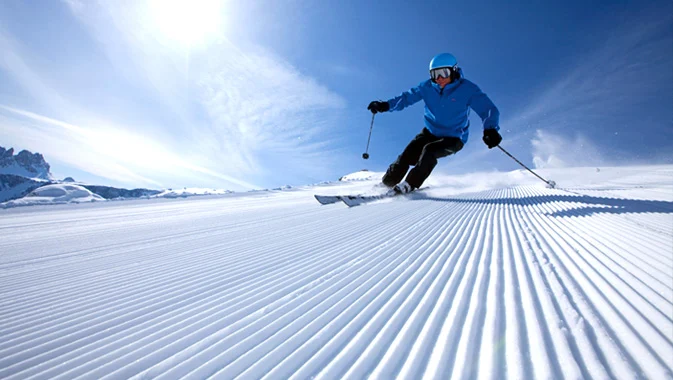
 Engines are starting to warm up for the winter season!!! …and just like with cars, before hitting the track, an optimal tune-up of the engine and mechanics is needed.
This holds true across all skill levels in alpine skiing. At the competitive level, physical conditioning has taken on ever-greater importance in recent years, recognized for its fundamental role in injury prevention and enhancing physical performance, as well as actively boosting the athlete’s perceived mental confidence.
By extension, the very same concepts apply to recreational skiing, where we can see the same benefits described above. A regular, moderate conditioning routine can bring enormous benefits once the recreational skier hits the slopes. These include greater confidence in one’s abilities, better endurance over time, better physical sensations, and an overall major boost in the sensory and motor pleasure that skiing provides.
Naturally, physical conditioning will vary in method and timing depending on the skier’s level and needs, so each individual situation should ideally be assessed and tailored to create an optimal program; even so, physical conditioning will bring benefits even when not individually customized.
A little care and body awareness on the part of the practitioner will be enough to make small adjustments that adapt the routines outlined below to each person’s individual needs.
Here we consider an intermediate skier (who tackles any slope with relative ease and decent technique…) looking to use one month to get ready for the winter season, assuming a generally sedentary lifestyle. This program is intended for healthy individuals. In the event of physical issues, our advice is to consult qualified professionals who can guide you on what and how to perform in a preparatory routine that respects your body and well-being.
3 physical conditioning sessions per week lasting about 1 hour each, performed on alternate days. Each option corresponds to one session; you can choose which option to perform, aiming to vary them as much as possible for greater variety and completeness in your training.
- OPTION A
- OPTION B:
- OPTION C:
- OPTION D:
- OPTION E:
– Half an hour of walking (if possible on mountain terrain with uphill and
downhill sections, optionally using trekking poles);
– 15′ of light stretching (especially for the leg and
back muscle groups).
– 10′ of breathing exercises.
– 5′ of light stretching
– 15 minutes of slow jogging (or 20 minutes of brisk walking at maximum speed);
– 5 minutes of light stretching;
– 15 minutes of core stability exercises;
– Quadriceps toning: bodyweight half-squats (5 sets
of 30 seconds of work). Rest 1.5 minutes at the end of each set.
– Single-leg hops: 40 seconds on each foot, repeated 4 times.
– 1 hour of cycling on easy-to-moderate terrain or 20 minutes on a stationary bike at medium
intensity;
– If cycling outdoors, do 10 minutes of stretching;
– If using a stationary bike:
– 5 isometric wall sits (photo 1) of 30 seconds each. Rest 2
minutes between sets;
– Leg bounces in a tuck position (photos 2 and 3): 5 sets of 45 seconds.
Rest 2 minutes between sets;
– Stretching.
– 30 minutes of aerobic exercise to music: first 7-8 minutes at low intensity, high-intensity middle phase, and final 5 minutes back at low intensity.
– 10 minutes of breathing exercises;
– Leg bounces in a tuck position (photos 2 and 3): 5 sets of 45 seconds.
Rest 2 minutes between sets.
– 10 minutes of running in place or jump rope;
– 15 minutes of core stability exercises;
– 5 isometric wall sits (photo 1) of 30 seconds each. Rest 2 minutes between sets;
– Leg bounces in a tuck position (photos 2 and 3): 5 sets of 45 seconds.
Rest 2 minutes between sets;
– Quadriceps toning: bodyweight half-squats (5 sets of 30 seconds of work). Rest 1.5 minutes at the end of each set;
– Single-leg hops: 40 seconds on each foot, repeated 4 times.

-

- pre-ski training figure 1

-
- pre-ski training figure 2

-
- pre-ski training figure 3

Completing this program will allow you to arrive at the ski slopes better prepared to enjoy your sport with greater safety and pleasure… and you will likely also begin to find satisfaction in regular physical activity, which, as everyone knows, has a major positive impact on anyone’s mental and physical well-being.
Have fun!
Article written by Patrick Mazzarol, ski instructor, coach, and athletic trainer at the Equipe Ski & Snowboard School in Falcade


No comments yet