









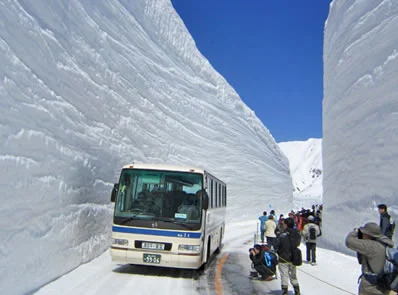
Anyone who loves snow has surely seen photos online of buses driving along roads carved between two towering walls of snow.
Most people think these images are merely photo montages or fakes circulating on the web, but that is not the case.
The famous images of buses surrounded by towering snow walls are real and were taken in Japan, along the “Tateyama Kurobe Alpine Route,” one of the most fascinating tourist routes in the world, crossing Japan’s highest mountain range and reaching nearly 3,000 m in altitude through some of the snowiest areas on Earth.

Every year from April to May, around 1 million Japanese visitors venture between the snow walls of this mountain range along a 37 km route covering nearly 2,000 m of vertical drop, served by 7 public transit lines using 5 different types of transport: funicular, cable cars, trolleybuses, buses, and on foot (if walking can be considered a form of public transport).
Originally, this route was built to construct a dam nestled among the mountains of this area; once construction was completed, the road was converted and extended to create a tourist link between the Toyama and Nagano prefectures.
The Alpine Route was developed with full respect for the environment in order to safeguard the integrity of the extraordinary natural heritage of these areas while promoting sustainable mountain tourism.
20 meters of Snow: the Snow Walls of Japan
Having explained all the “technical and tourist” features of the route, it is time to describe the aspect that interests us most of all: the SNOW.
As we mentioned at the beginning of this article, this is one of the snowiest areas in Japan and quite possibly on the entire planet. The snow walls visible in the photos measure from 7 to 10 meters in height and are not the result of avalanches, but rather of the heavy snowfalls that blanket these mountains throughout the winter.
If you think 10 meters of snow is a lot, you should know that over the course of the winter season up to a full 20 meters of snow can accumulate.
Along the route there are also hospitality facilities such as hotels and mountain huts that serve as a base for those heading out on snowshoe hikes or climbing the slopes to practice ski mountaineering.


How do you clear 20 meters of Snow?
Naturally, this road does not open by itself: when the harsh winter weather gives way to sunshine and milder temperatures, snowplows head up to high altitude and begin the long, arduous task of snow clearing. Tackling this daunting job are powerful heavy-duty machines (excavators and bulldozers) that use all their might to move massive volumes of snow and gradually carve out the corridor that tourists will travel through during the spring season.
Below is a video that needs no further commentary:
A true spectacle for snow lovers like us—now whenever someone tells you it’s all a photo montage, you can share a link to this article and prove them wrong! Paradise exists, and it is in Japan!

P.S.: Italy is no slouch either—just take a look at these images taken at Sella Nevea in spring 2009


No comments yet