









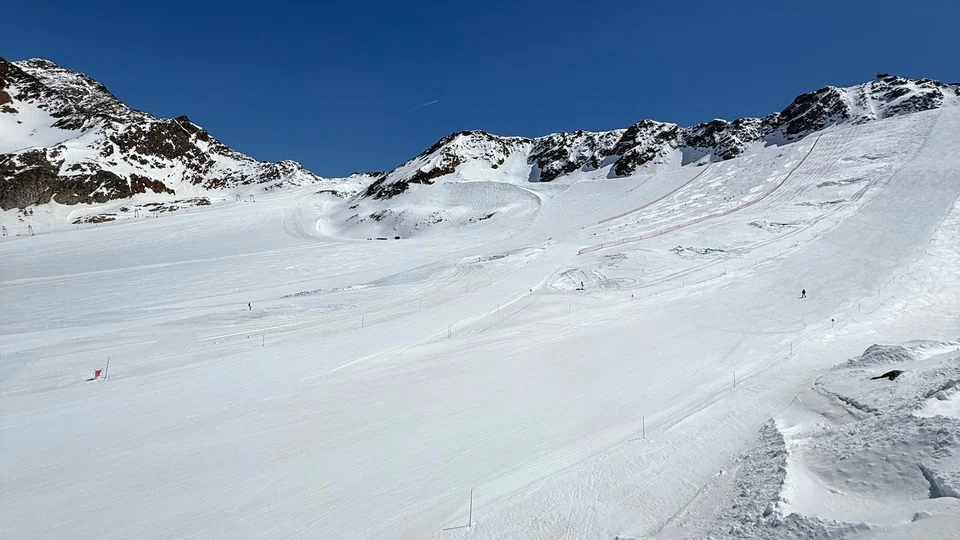
Anyone heading up to ski on Alpine glaciers in autumn is now used to seeing the quiet work that precedes the opening of the slopes: vast expanses of white tarps removed at the end of summer to uncover the snow preserved beneath the July and August sun. At the Alpin Arena Senales, in South Tyrol, this well-established practice for managing high-altitude ski areas took an unprecedented step forward this summer. As part of the MINI Takes Care project, launched together with the Val Senales lift company, new geotextile tarps made from natural biodegradable fibers were tested—designed not only to protect the snowpack during the warmest months while reducing the release of fossil-based microplastics, but also to be recovered at the end of their service life and transformed into yarns, fabrics, and clothing.
To understand the purpose of this trial, one has to start with the numbers and the daily work carried out above three thousand meters. Every spring, the Val Senales ski area produces over 300,000 cubic meters of technical snow: part of it is spread directly onto the glacier to reinforce the snowpack, while the rest is piled into large depots meant to last through the summer. During the warm months, the covers protect both these stockpiles and around nine hectares of glacier surface. It was on a section of the areas usually covered that the new cellulose tarps were laid this year, put to the test against high-altitude wind, temperature swings, and solar radiation. When the tarps are lifted in autumn, the snow preserved in the depots becomes available once again for snowcats to prepare the runs and guarantee the first openings even if autumn storms are slow to arrive.
From snowfarming to protecting key high-altitude passages
The mechanism behind summer snow depots is snowfarming, a technique that over the past fifteen years has spread across many Alpine resorts, even at altitudes well below the glaciers and even to prepare cross-country ski loops. The principle consists of stockpiling snow when temperatures are favorable and insulating it from warm air and sunlight until it is time to redistribute it onto the slopes. The final yield depends on the aspect of the pile, summer weather patterns, and above all the insulating material chosen. Alongside geotextile tarps, several resorts use layers of sawdust or woodchips: a study conducted after the summer of 2015 on depots in Davos, Switzerland, and Val Martello, South Tyrol, documented that by the end of the warm season 74% and 63% of the initial snow volume remained intact, thanks to covers made of sawdust in Davos and a mixture of sawdust and woodchips in Val Martello.
Laying tarps directly over a glacier ski run, however, serves an even more delicate goal than simply preserving a stockpile. Here it is not just a matter of banking snow to be moved in autumn with bulldozers and snowcats, but of preserving in place the snowpack and the underlying glacial ice at key points of the ski area. The bright surface of the tarps reflects a significant share of solar radiation, while the thickness of the fabric slows thermal exchange, curbing summer melt right along lift lines or ski runs.
Data gathered over nearly twenty years of surveys confirm how effective this shield is on the surfaces actually covered. In Italy, measurement campaigns conducted between 2008 and 2012 on Dosdè Est (in the Cima Piazzi group) and Presena Ovest recorded a reduction in melting of 69% and 49% respectively in direct comparison with adjacent uncovered areas. Similar experiences have long shaped the management of Swiss glaciers as well: on the Gemsstock, above Andermatt, tarps have been used since 2004 to safeguard the ice ramp essential for skiers to enter the slope from the cable car exit, while on the Diavolezza summer covering allowed a small glacier tongue reduced to a bare minimum to actually regain thickness, a result documented as early as 2021. Naturally, this is always a local, targeted benefit: wrapping an entire glacier system would entail out-of-reach costs and logistical complexity, but for a ski resort, saving the thickness of a connecting trail, a lift unloading area, or a central steep pitch means maintaining continuity across the slopes and opening the season on schedule.
The microplastics issue and the cellulose breakthrough
Yet the very operational success of these tarps has raised an environmental question in recent years tied to their composition. Most traditional geotextiles are made from synthetic polymers such as polypropylene or polyester. Exposed for months to high-altitude ultraviolet rays, nighttime frost, and the mechanical stress of the machinery that lays and removes them, these sheets inevitably wear down, leaving tiny synthetic fragments and fibers in the snow.
The scale of the phenomenon was measured precisely on the Grande Motte glacier in Tignes, France, where between 2020 and 2023 researchers compared different types of covers. The findings, presented in 2024 at the European Geosciences Union (EGU) general assembly, showed that particles shed by permeable polypropylene tarps can infiltrate the snowpack to a depth of over one meter, whereas with impermeable PVC sheets the transfer of microplastics remains concentrated mainly in the snow layer in direct contact with the cover. With the summer thaw, meltwater then risks carrying these synthetic fibers into mountain streams and valley floor ecosystems.
In Austria, the PLASTIC.ALPS research project coordinated by the University of Innsbruck addressed this issue, identifying polypropylene geotextiles as a localized but concretely eliminable source of contamination and launching the development and high-altitude testing of entirely cellulose-based covers. The trial brought to Val Senales builds directly on this scientific work: the new tarps adopted at the Alpin Arena use wood-cellulose fibers produced by the Austrian group Lenzing, certified by TÜV Austria for both compostability and biodegradability across different natural environments. While tests on the South Tyrolean glacier evaluate their mechanical strength, durability, and thermal effectiveness compared with conventional sheets, the use of cellulose aims to cut the release of fossil-derived microplastics into the snow.
From glacier to loom: how a piece of clothing is born
The fact that the new covers are biodegradable does not mean, however, that they are left to decompose on the mountain. From the outset, the project provides for the complete recovery of the tarps at the end of their use so they can enter a circular textile supply chain, where the retired cover becomes raw material for clothing. The tracked collection of the retired glacier tarps is handled by SAFE, while industrial processing is led by the Biella-based wool and cotton group Marchi & Fildi. Knowing the exact origin, composition, and usage history of the tarps retrieved from high altitude, the Piedmontese company can channel them into a mechanical recycling process: the geotextile is shredded and returned to fiber form, ready to be spun once again. In the yarn developed by Marchi & Fildi for the MINI Takes Care initiative, the main share consists of fibers recovered from the glacier tarps, combined with a smaller percentage of virgin Lyocell, which also belongs to the family of wood-derived cellulosic fibers.
That this transition from glacier to wardrobe works on an industrial scale has already been demonstrated by an actual garment created under Glacial Threads, the pioneering project that preceded the Val Senales test. In March 2024, Lenzing unveiled the Glacier Jacket, a denim jacket crafted by combining the expertise of Marchi & Fildi, the historic weaving mill Candiani Denim, and the fashion studio Blue of a Kind. To make it, Candiani used the yarn regenerated from the tarps in the weft of a special white denim, weaving the glacier-tested fibers with organic cotton and TENCEL Lyocell produced with REFIBRA technology. Following that first milestone, the path launched in Val Senales with MINI Takes Care is already looking ahead to upcoming collections: a collaboration with Napapijri to produce bags and new apparel developments once again created alongside Candiani are already in the pipeline.


No comments yet