









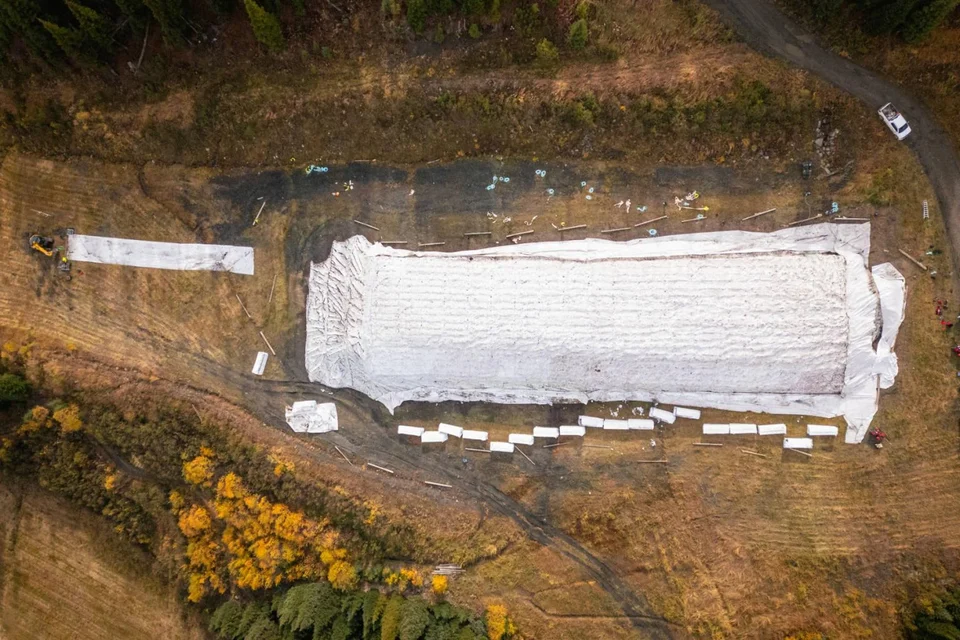
The Tod Mountain project has expanded after its first year. Stored snow prepares training lanes and allows snowmaking resources to focus on other pistes.
At Sun Peaks, some of the snow intended for the start of winter does not need to fall again: it spent the summer on Tod Mountain, stored beneath insulating covers. The British Columbia resort has expanded the snow preservation project launched in 2025, increasing it to three large stockpiles. This is work that begins many months before skiers take their first lift ride.
In its 26 October announcement, the operator reports approximately 17,000 cubic metres of snow in each stockpile, with 80–85% preserved through the warmer months. The covers are Snow Secure insulating mats. Once these are removed, the snow is recovered and distributed wherever it is needed to prepare the surface.
The first training lanes are not the same as a public opening
The snow is initially intended for the Nancy Greene International Race Centre, where training is scheduled to begin on 6 November. The public opening of the 2026/27 season, by contrast, is planned for Saturday 21 November. These are two different stages: seeing a piste prepared for teams does not mean that visitors can buy a day pass and ski freely throughout the resort.
The benefit for other visitors lies in how the work is organised. By using the preserved snow for training lanes, the snowmaking team can concentrate resources on the 5 Mile run and the areas for beginners as well. Stored snow therefore does not replace all the autumn preparations, but provides a ready supply for a specific sector.
Preserving snow and making snow are two different jobs
Snowfarming preserves a quantity of snow accumulated earlier for use at a later time. Snowmaking, on the other hand, produces new snow when conditions allow. At Sun Peaks, the two methods are used together: the resort is in the third year of a six-year snowmaking improvement programme worth 5.5 million Canadian dollars.
The work described for the coming winter includes automation, weather monitoring and tower-mounted snow guns. The grooming fleet is changing too, with two new machines intended for the park and cross-country skiing. These improvements are less immediately visible than a new chairlift, but they affect what skiers find beneath their skis.
For anyone choosing an early-season departure, the decisive information nevertheless remains what is actually available to the public. The three stockpiles do not guarantee a particular number of open pistes, just as 21 November is a scheduled season opening rather than an already confirmed operating report. Above all, the development shows how the resort is preparing for that date: preserving some of its snow, allocating resources and working on the sectors that must support the first days of skiing.


No comments yet